If you are buying Blackwell at volume, Supermicro is hard to route around. No other OEM ships as many distinct HGX B200 and B300 chassis, in both air-cooled and direct-liquid-cooled (DLC) form, with the same rack-scale integration program behind them. That breadth is the practical reason Supermicro tends to become the default building block for HGX deployments: when one chassis is allocation-constrained, there is usually a second one with the same GPU baseboard and a different cooling or CPU pairing that is not.
This is an OEM spotlight, not an announced partnership. Supermicro is a qualified member of the OEM ecosystem that Rillor lists and can source as a verified seller and underwriter. The systems below are real, the model numbers are real, and the reference prices come from the Rillor tape as indicative pre-launch figures. What follows is the lineup as a procurement lead should actually evaluate it, node by node, with the Rillor SKU mapping made explicit.
The air-cooled HGX baseline: B200 and B300 8-GPU nodes
Most Blackwell buyers start at the 8-GPU HGX node, and Supermicro covers it from two directions at once.
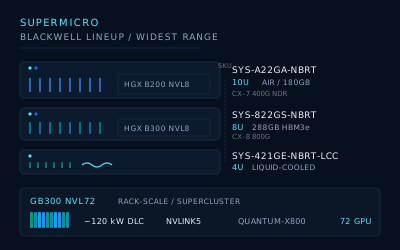
The SYS-A22GA-NBRT is the air-cooled flagship for the prior-step Blackwell part. It is a 10U system holding eight NVIDIA SXM HGX B200 GPUs with 1.4TB of total GPU memory, dual Intel Xeon 6900-series CPUs across 24 DDR5 DIMM slots, and six 5250W Titanium-level redundant power supplies. Ten rack units is deliberate. Air-cooling eight 1000W-class GPUs plus a dual-socket head node needs the airflow volume, and the extra height buys you a deployment that does not require facility water. For an operator standing up a hall on conventional CRAC or in-row air, this is the node that does not force a cooling retrofit before the first GPU lands.
The B300 step is where the chassis designation changes in a way worth flagging at the PO line, because it is an easy place to order the wrong thing. The 8U HGX B300 system is officially SYS-822GS-NB3RT. The "NB3RT" suffix denotes B300; the older "NBRT" suffix is the B200 variant. They are not interchangeable, and a quote that says "822GS-NBRT" is quoting the wrong generation. The B300 node carries eight GPUs at 288GB HBM3e each, a meaningful capacity step over B200's 180GB, and it integrates NVIDIA ConnectX-8 networking at up to 800Gb/s per GPU directly.
That networking jump is the real generational story at the node level, and it is covered in more depth in our B200 versus B300 system comparison. On B200, the fabric is eight discrete ConnectX-7 NICs at 400Gb/s each (400G NDR). On B300, ConnectX-8 is integrated at 800Gb/s per GPU, which yields 6.4Tbps of total system network bandwidth, roughly double the prior generation. Independent teardowns confirm the same picture, and note that a 48U ORV3 rack can hold up to 144 B300 GPUs once the nodes are racked at density. If your bottleneck is collective communication across a large training job, the B300 fabric is the reason to pay the step-up rather than the HBM3e capacity alone.
The AMD EPYC option
CPU vendor is not dictated by the GPU baseboard, and Supermicro proves it with the AS-A126GS-TNBR: a 10U dual-AMD-EPYC-9005 system carrying eight NVIDIA HGX B200 180GB GPUs over NVLink and NVSwitch, supporting EPYC processors up to 192 cores at 500W TDP. For shops standardized on EPYC Turin head nodes, this removes the awkward "Blackwell means Intel" assumption. The two relevant Turin parts are the EPYC 9655 (96 cores) and the EPYC 9555 (64 cores), both Zen 5 on socket SP5. Which one you want depends on whether the head node is doing real data-pipeline work or just feeding the GPUs; we break down the tradeoff in Granite Rapids versus EPYC Turin for GPU server head nodes.
On the Intel side, the comparable head-node ceiling is the Xeon 6980P (Granite Rapids-AP): 128 cores, 256 threads, 504MB cache, 500W TDP, 12 memory channels, with DDR5 and MRDIMM support up to 8800 MT/s. For an 8-GPU node the practical question is rarely raw core count and more often memory bandwidth into the staging buffers, which is why the channel count and MRDIMM ceiling matter as much as the core specification.
Direct-liquid cooling: where density actually lives
Air-cooled HGX is the floor, not the ceiling. As per-GPU power climbs, air runs out of headroom, and the deployments pushing the highest rack density move to DLC. Supermicro's air-versus-liquid split is wide enough that you can pick the cooling regime to match the facility rather than the other way around, a tradeoff we cover in air versus direct-liquid cooling for Blackwell.
The SYS-421GE-NBRT-LCC is the compact end of that range: a 4U direct-liquid-cooled HGX B200 8-GPU system (B200 at 180GB SXM) supporting up to 8TB of DDR5 across 32 DIMM slots, deployable with a 250kW coolant distribution unit. Going from 10U air to 4U liquid for the same eight-GPU baseboard is the headline. You roughly halve the rack height per node, which is the entire point of liquid: more compute per rack, fewer racks per hall, shorter cable runs, and a power-and-thermal envelope that air simply cannot reach. If your constraint is floor space or fabric reach rather than facility water availability, the 4U DLC node is the denser answer.
The cooling capacity claim is worth grounding. Supermicro's in-house liquid-cooling line provides CDUs that remove up to 250kW of heat per rack, with in-row CDUs scaling to 1.8MW across multiple racks. That is not a third-party bolt-on. It is manufactured by the same vendor shipping the compute, which matters when you need the cooling and the nodes to land on the same schedule and be supported under one warranty.
GB300 NVL72: rack-scale as a building block
Above the 8-GPU node sits the rack-scale tier, and here the unit of purchase stops being a server and becomes a rack. NVIDIA GB300 NVL72 integrates 72 Blackwell Ultra GPUs and 36 Grace CPUs in a single rack, with 20TB of total GPU memory, fifth-generation NVLink delivering 130 TB/s, ConnectX-8 SuperNIC at 800Gb/s per GPU, and Quantum-X800 InfiniBand. The whole rack behaves as one NVLink domain, which is the architectural reason it exists: the largest models want a coherent fabric across all 72 GPUs, not 72 GPUs stitched together over a slower network. We compare the two rack-scale generations in GB200 NVL72 versus GB300 NVL72 at rack scale.
Supermicro delivers GB300 NVL72 through its SuperCluster and Data Center Building Block Solutions (DCBBS) program, and this is the part that distinguishes a rack-scale OEM from a node vendor. DCBBS performs L11 (node-and-rack-level) and L12 (multi-rack with customer software) integration and validation in-house. In plain terms: the rack is plumbed, cabled, powered, burned in, and validated as a unit before it ships, rather than arriving as parts to be assembled on your floor. At roughly 120kW per DLC rack, that pre-integration is not a convenience. It is the difference between a rack that powers on and a multi-week on-site debugging exercise.
What actually differentiates Supermicro
Strip away the spec sheets and three things separate Supermicro from a vendor that merely resells the same NVIDIA baseboards.
Manufacturing scale and chassis breadth. Supermicro fields more distinct Blackwell SKUs than any single OEM, across air and liquid, Intel and AMD. For a buyer, breadth is supply resilience: when one configuration is allocation-constrained, an equivalent one usually is not. Concentrating an entire buildout on a single chassis from a single OEM is a known failure mode, and we lay out the mitigation in how to avoid single-OEM lock-in across a multi-rack GPU buildout.
In-house liquid cooling. The CDUs, manifolds, and in-row units are Supermicro's own, manufactured at plant scale rather than sourced from a separate cooling vendor. As Blackwell pushes more deployments to DLC, owning that supply chain means the cooling and the compute ship on one schedule under one support contract.
Rack-level integration with L11 and L12 testing. For GB300 NVL72 and dense DLC clusters, the value is not the node, it is the validated rack. DCBBS turns a rack into a tested, single-warranty deliverable, which is what you want when each rack is a six-or-seven-figure line item.
Rillor SKU mapping and reference pricing
Rillor resolves these systems onto commodity-grade reference SKUs, a base SKU per grade with cooling, certification, and CPU captured as priced differentials, so a forward price exists per grade rather than per bespoke quote. The mapping for the Supermicro line:
| Supermicro system | Form / cooling | Rillor SKU | Indicative reference (USD) |
|---|---|---|---|
| SYS-A22GA-NBRT (HGX B200, 8 GPU) | 10U, air-cooled | RIL-GX-B200-2T | ~$349K per system |
| SYS-822GS-NB3RT (HGX B300, 8 GPU) | 8U, air-cooled | RIL-GX-B300-2T | ~$381K per system |
| GB300 NVL72 (72 GPU, 36 Grace) | Rack-scale, DLC | RIL-NVL72-GB300 | priced per rack on the tape |
Those per-system figures are indicative pre-launch reference points from the Rillor tape, not retail list. A Rillor forward also carries the standard terms: a 10% deposit at execution with the balance at delivery, an independent escrow agent, a seller performance bond, NVIDIA channel compliance with the end-customer-of-record captured, and physical delivery always. Each one is a bilateral, RFQ-based forward with intent of physical delivery, a master forward purchase agreement negotiated per ticket rather than matched against a common order book, never cash-settled, which is the distinction we draw in forward contracts versus futures for GPU systems. (Escrow and bonding are by design; the desk is pre-launch.)
A consistent commodity-grade SKU is also what gives the Rillor Compute Index something stable to price. The index is a broadly-sourced benchmark per SKU-grade, assessed from many inputs under a transparent, IOSCO-aligned methodology: Rillor's own contracts and RFQs, OEM list prices, distributor quotes from TD Synnex, Ingram, and Arrow, broker prints, secondary-market data, and surveyed bids and offers. Rillor's own forward flow on Supermicro Blackwell systems is one privileged input, not the whole computation, which is why a thin spot quote and an assessed forward price diverge. Rillor governs the methodology and licenses it to funds and venues, and never cash-settles against it. The index is methodology and roadmap today, not yet a live computed feed. You can see the SKU set on the marketplace and the full catalog under SKUs.
How a buyer should approach the lineup
For a procurement lead, the decision tree is short. If the facility is air-cooled and you want the lowest-friction Blackwell deployment, the SYS-A22GA-NBRT (RIL-GX-B200-2T) is the baseline. If you need the HBM3e capacity step and the doubled ConnectX-8 fabric, move to the SYS-822GS-NB3RT (RIL-GX-B300-2T). If density or floor space is the binding constraint and facility water is available, the 4U DLC SYS-421GE-NBRT-LCC compresses the same eight-GPU baseboard into half the height. And if you are sizing a frontier-scale training cluster, GB300 NVL72 (RIL-NVL72-GB300) is the rack-scale unit, delivered pre-integrated through DCBBS. For the broader exercise of sizing a cluster end to end, see how to spec a Blackwell training cluster from node to fabric.
To lock a Supermicro B300 system at a known forward price, with escrow and a performance bond behind delivery, start a quote on the SKU. Access to the Rillor marketplace is invite-only, and qualified buyers can begin at for buyers.
See the forward price on this system.
Request indicative pricing, lead time, and delivery windows for this SKU. Every quote runs through the Rillor RFQ, deposit, and escrow flow, settling in a bilateral physical-delivery forward.
Request pricing →- SYS-A22GA-NBRT | 10U SuperServer | Supermicro
- SYS-822GS-NB3RT | 8U GPU Server | Supermicro
- SYS-421GE-NBRT-LCC | 4U Liquid-Cooled SuperServer | Supermicro
- AS-A126GS-TNBR | 10U GPU A+ Server | Supermicro
- NVIDIA GB300 NVL72 | Data Center | NVIDIA
- Checking Out the Supermicro NVIDIA B300 Solutions and What it Takes to Build an AI Factory | ServeTheHome
- Data Center Building Block Solutions (DCBBS) | Supermicro
- Intel Xeon 6980P Processor Product Specifications | Intel
- AMD EPYC 9655 (5th Gen EPYC, Turin) | AMD