
Research reportPublic communications and markets

What studies find on social media posts and market moves

What published studies find on social media posts and the stock market: effects that depend on topic, tone, asset and data frequency, null results, and moves that fade within days.

Cover of the full report: What studies find on social media posts and market moves
The research behind this article, with every source listed. 19 pages.

Key points

From the Summary of the full report

  1. Six studies of a U.S. president's posts naming listed companies disagree. Two found price moves that faded or partly reversed within days [8, 9], one found declines after negative posts about non-media firms, largely reversed the next day [12], one found no lasting price effect [13] and two found no significant average effect [10, 11].
  2. Tone changes the answer between samples. Brans and Scholtens found strongly negative posts followed by lower company value and supportive posts with no significant effect [11]. Kinyua and coauthors found positive market reactions to both strongly positive and strongly negative posts [15].
  3. With minute-by-minute futures data on 8,686 posts from a U.S. president's account to September 2019, Gjerstad and coauthors found that most topics did not move markets, and that trade-war posts were followed by lower U.S. stock prices, more trading and more uncertainty [14].
  4. Posts from a U.S. president's account criticizing the Federal Reserve, timed to the second against fed funds futures from 2015 to 2021, lowered expected policy rates, while randomly chosen other posts from the account showed no significant effect [23].

Do social media posts move the stock market? Published studies of social media posts and the stock market, most of them on posts from one U.S. president's account, find effects that depend on the topic, the tone, the asset and how finely prices are measured. Several found no significant average effect [10, 11, 35], and many of the effects that did appear faded within hours or days [8, 9, 12, 14].

This report sets the event studies side by side and gives null results the same space as effects.

What studies find on social media posts and the stock market

Six studies tested whether a U.S. president's posts that named listed companies moved those companies' stocks [8, 9, 10, 11, 12, 13].

Study Posts Prices Result
Born, Myers and Clark 15 [11] Event-day open and close Moves with the post's tone, not significant within five trading days [8]
Ge, Kurov and Wolfe 48 [11] Not stated in the abstract Moves in price, volume and volatility, some reversal in the next few trading days [9]
Juma'h and Alnsour 58 [11] Daily No significant effect on average [10]
Brans and Scholtens 100 [11] Daily Average abnormal return of 0.1% on the post day and -0.07% the next, neither significant [11]
Ajjoub, Walker and Zhao 513 [12] Not stated in the abstract Declines after negative posts about non-media firms, largely reversed the next day [12]
Machus, Mestel and Theissen Not stated in the abstract Minute by minute More trading, no lasting price effect [13]

The samples range from 15 to 513 posts [11, 12], and the rules for choosing them differ. Brans and Scholtens kept 100 of over 5,600 posts after excluding retweets and companies with mergers, splits, profit warnings or top-management changes [11]. Ajjoub, Walker and Zhao kept 513 of 6,983 posts and found that the response depended on the firm: for media firms positive posts had a pronounced positive price impact, and for non-media firms negative posts were followed by declines [12].

Trading responded more consistently than prices [8, 9, 13]. Born and coauthors found trading volume and search activity rising with the posts, which they read as transitory trading by small or noise traders [8]. Ge and coauthors found higher volume, volatility and institutional investor attention [9].

Tone changes the answer

Splitting posts by tone gives conflicting results. Brans and Scholtens scored posts with SentiStrength, a word-list tool, and found strongly negative posts followed by lower company value, with supportive posts showing no significant effect [11]. The gap between negative and positive posts was significant at the 10% level [11]. Ge and coauthors, who coded tone by hand, found no significant difference between negative and positive posts [11]. Kinyua and coauthors, with 30-minute windows on the Dow Jones Industrial Average and the S&P 500, found positive market reactions to strongly positive and strongly negative posts alike [15].

The ways of scoring tone, from word lists to language models, are compared in Dictionaries, FinBERT or language models for financial sentiment.

Effects measured in minutes

Gjerstad, Meyn, Molnár and Næss matched 8,686 posts to minute-by-minute futures on the S&P 500, the VIX, WTI crude, the Hang Seng and gold to September 2019 [14]. Pooled over all posts, the S&P 500 effect was negative, not very significant and gone within an hour, while trading volume stayed higher for at least an hour [14]. After posts containing "products", returns fell about 30 basis points over 60 minutes, and after "tariff" about ten basis points, with both effects gone within two hours [14]. Most topics did not affect markets. Trade-war posts were followed by lower U.S. prices, more trading, more uncertainty, a negative response in Chinese stocks and a positive one in gold [14].

Burggraf, Fendel and Huynh found that posts on the U.S.-China trade war negatively predicted S&P 500 returns and positively predicted the VIX [16]. Nishimura, Dong and Sun found that posting raised volatility and jumps in the later part of their sample [17], and Nishimura and Sun found higher volatility in German, French and UK stocks, rising with attention to the posts [18].

Currencies, oil and interest rates

Mexico-related policy posts raised the peso's volatility [19]. Escalating negative sentiment in Russia-related posts was followed by a ruble depreciation of 4% to 10% over about three days, while sanctions not accompanied by negative posts did not cause depreciation [20]. Posts with macroeconomic policy or trade content were followed by a stronger dollar and lower intraday volatility [21]. Some posts raised the likelihood of a wider spread between WTI and Brent crude [22].

Bianchi, Kind and Kung timed posts criticizing the Federal Reserve to the second against tick-by-tick fed funds futures and found that expected policy rates fell, while placebo tests with randomly selected other posts gave coefficients close to zero [23]. Their design is one of the cases in the event-study methods note. Tillmann found that the president's statements on the Fed lowered long-term interest rates on average, with an impact that declined over time [24].

A chief executive's posts as disclosure

In April 2013 the SEC said companies can announce key information on social media in compliance with Regulation FD, provided investors have been alerted to the channels [2]. The occasion was a post by a streaming company's chief executive on his personal Facebook page, set out in company disclosure timing and the 23-hour trading day [3].

In 2018 the SEC alleged that an electric-car maker's chief executive posted false and misleading statements about taking the company private at $420 per share with funding secured, and that the posts caused the stock to jump by over 6% on 7 August 2018 [4]. He and the company settled without admitting or denying the allegations [5]. The terms required him to step down as chairman for three years and each to pay a $20 million penalty, and the company, which had told the market in 2013 that it intended to use his account to announce material information, was charged with lacking disclosure controls over his posts [5]. A 2023 Second Circuit summary order upheld the district court's refusal to modify or end the consent decree, which requires him to follow the company's policy of pre-approval of covered posts by company lawyers, and the Supreme Court denied a petition for a writ of certiorari on 29 April 2024 [6, 7].

Crypto assets and one executive's posts

Ante studied 47 crypto-related posting events by the same chief executive [25]. Price effects were significant on average for Dogecoin-related posts and not for Bitcoin, where positive and negative effects cancel out, and individual posts moved Bitcoin's price up by 16.9% or down by almost 11.8% [25]. With daily data, Huynh found that the tone of 10,850 posts had a Granger causal relation with Bitcoin returns, with reversal effects and no link to volatility [27].

Crowd posts and mood indexes

Bartov, Faurel and Mohanram found that the aggregate opinion in individual posts predicted firms' quarterly earnings and announcement returns from 2009 to 2012 [29]. A 2011 paper reported 87.6% accuracy in predicting the daily up and down changes of the Dow Jones Industrial Average from a Twitter mood series [31]. Lachanski and Pav could not reproduce its p-value pattern and found no evidence that mood helped predict the market out of sample [32].

In January 2021, the SEC staff found, GameStop and other stocks rose sharply "as bullish sentiments of individual investors filled social media", and positive sentiment sustained the weeks-long rise [34]. A Federal Reserve discussion paper found that overnight sentiment in posts helped predict next-day stock returns [33].

Why the studies disagree

The studies differ in four ways that change results:

  • Selection. Posts picked by hand or by content, against every post except retweets [11, 14, 21].
  • Data frequency. Daily closes against minute and tick data. The pooled and keyword effects in the minute-level data faded within one to two hours, while the trade-war topic's effect on the S&P 500 stayed significant through the full two-hour window [14]. One daily study calls the lack of high-frequency data a limitation [11], and another does not rule out intraday reactions [35].
  • Timing and cause. Prices and trading began to move before posts in two minute-level studies [13, 14]. One reads this as posts commenting on events that had already drawn attention [13], the other as consecutive posts on the same topic [14].
  • Missing posts and outliers. One archive missed posts deleted within a day before 27 January 2017, and one large drop was removed from that sample [11].

For 2025 posts, a May 2026 bachelor's thesis at Lund University used daily data and found no significant association between tariff posts and daily VIX changes [35]. Tariff-related posts were assigned to 56 of 85 trading days, leaving 29 comparison days [35].

What a study of posts needs

Each of these practices comes from a study above: timestamps to the minute or the second [14, 23], every post kept as issued, deletions included [11], a baseline of ordinary windows or placebo posts [14, 23], a stated rule for choosing posts [11, 12, 21], null results reported in full [10, 11, 35], and a test outside the sample that produced the finding [32].

Rillor's event and news response work runs event studies on a time-aligned corpus of public communications, each statement kept as issued with its timestamp and paired with the price moves in a declared window around it.

Read the full report

The full report adds each study's sample, data and window, and the SEC record through the 2024 Supreme Court docket.

The full report

What studies find on social media posts and market moves

The research behind this article, with every source listed. 19 pages.

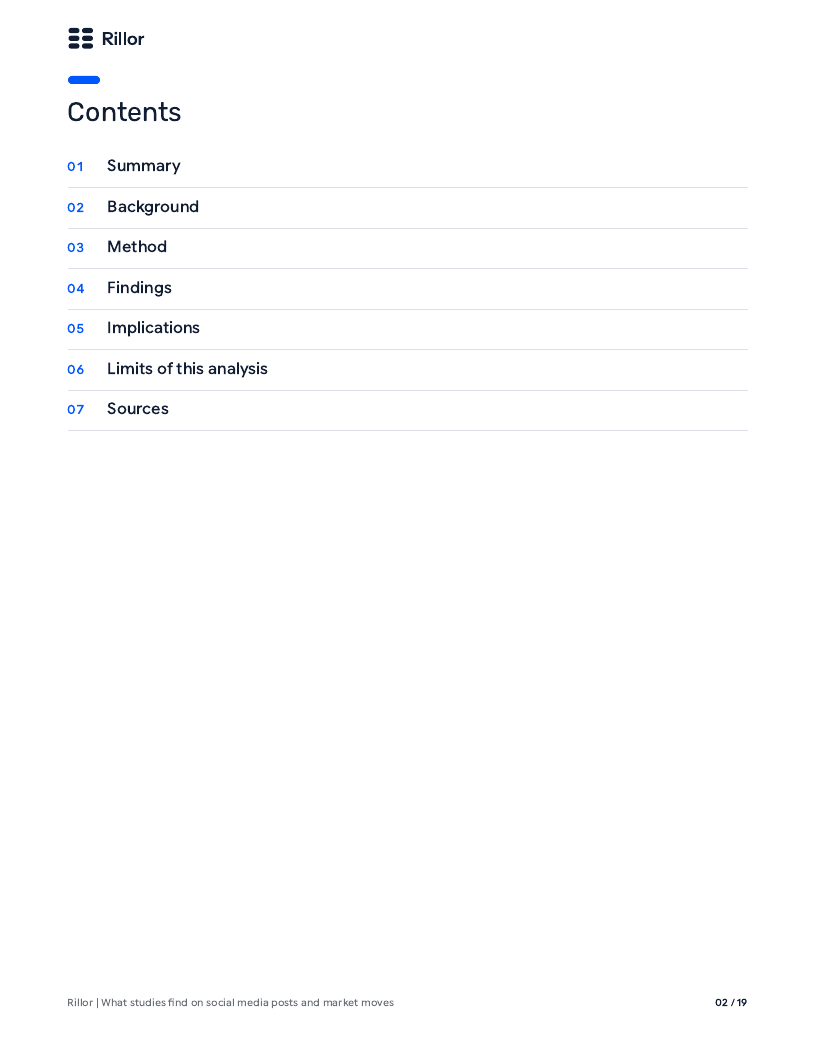
  1. Summary
  2. Background
  3. Method
  4. Findings
  5. Implications
  6. Limits of this analysis
  7. Sources

Sources

  1. SEC Says Social Media OK for Company Announcements if Investors Are Alerted. Press Release 2013-51. U.S. Securities and Exchange Commission, 2 April 2013, viewed 8 November 2026. https://www.sec.gov/newsroom/press-releases/2013-2013-51htm
  2. Report of Investigation Pursuant to Section 21(a) of the Securities Exchange Act of 1934: Netflix, Inc., and Reed Hastings. Release No. 34-69279. U.S. Securities and Exchange Commission, 2 April 2013, viewed 8 November 2026. https://www.sec.gov/files/litigation/investreport/34-69279.pdf
  3. Elon Musk Charged With Securities Fraud for Misleading Tweets. Press Release 2018-219. U.S. Securities and Exchange Commission, 27 September 2018, viewed 8 November 2026. https://www.sec.gov/newsroom/press-releases/2018-219
  4. Elon Musk Settles SEC Fraud Charges; Tesla Charged With and Resolves Securities Law Charge. Press Release 2018-226. U.S. Securities and Exchange Commission, 29 September 2018, viewed 8 November 2026. https://www.sec.gov/newsroom/press-releases/2018-226
  5. Securities and Exchange Commission v. Musk, No. 22-1291, Summary Order. United States Court of Appeals for the Second Circuit, 15 May 2023, viewed 8 November 2026. Court document as posted by Courthouse News: https://www.courthousenews.com/wp-content/uploads/2023/05/22-1291-SEC-musk-ruling.pdf
  6. Docket No. 23-626, petition for a writ of certiorari to the Second Circuit, No. 22-1291. Supreme Court of the United States, docketed 11 December 2023, viewed 8 November 2026. https://www.supremecourt.gov/search.aspx?filename=/docket/docketfiles/html/public/23-626.html
  7. Trump tweets and the efficient Market Hypothesis. Jeffery A. Born, David H. Myers and William J. Clark, Algorithmic Finance 6(3-4), 103-109, 2017, viewed 8 November 2026. IDEAS record: https://ideas.repec.org/a/ris/iosalg/0062.html
  8. Do Investors Care About Presidential Company-Specific Tweets? Qi Ge, Alexander Kurov and Marketa Halova Wolfe, Journal of Financial Research 42(2), 213-242, July 2019, viewed 8 November 2026. IDEAS record: https://ideas.repec.org/a/bla/jfnres/v42y2019i2p213-242.html
  9. Using Social Media Analytics: The Effect of President Trump's Tweets On Companies' Performance. Ahmad H. Juma'h and Yazan Alnsour, Accounting and Management Information Systems 17(1), 100-121, March 2018, viewed 8 November 2026. IDEAS record: https://ideas.repec.org/a/ami/journl/v17y2018i1p100-121.html
  10. Under his thumb the effect of president Donald Trump's Twitter messages on the US stock market. Heleen Brans and Bert Scholtens, PLOS ONE 15(3), e0229931, 11 March 2020, viewed 8 November 2026. https://journals.plos.org/plosone/article?id=10.1371/journal.pone.0229931
  11. Social media posts and stock returns: The Trump factor. Carl Ajjoub, Thomas Walker and Yunfei Zhao, International Journal of Managerial Finance 17(2), 185-213, 2021, online 4 June 2020, viewed 8 November 2026. https://www.emerald.com/insight/content/doi/10.1108/IJMF-02-2020-0068/full/html
  12. Heroes, just for one day: The impact of Donald Trump's tweets on stock prices. Tobias Machus, Roland Mestel and Erik Theissen, Journal of Behavioral and Experimental Finance 33, 100594, 2022, viewed 8 November 2026. IDEAS record: https://ideas.repec.org/a/eee/beexfi/v33y2022ics2214635021001386.html
  13. Do President Trump's tweets affect financial markets? Peder Gjerstad, Peter Filip Meyn, Péter Molnár and Thomas Dowling Næss, Decision Support Systems 147, 113577, 2021, viewed 8 November 2026. Open copy in the Norwegian national research archive: https://hdl.handle.net/11250/3001301
  14. An analysis of the impact of President Trump's tweets on the DJIA and S&P 500 using machine learning and sentiment analysis. Johnson D. Kinyua, Charles Mutigwe, Daniel J. Cushing and Michael Poggi, Journal of Behavioral and Experimental Finance 29, 2021, viewed 8 November 2026. IDEAS record: https://ideas.repec.org/a/eee/beexfi/v29y2021ics2214635020303762.html
  15. Political news and stock prices: evidence from Trump's trade war. Tobias Burggraf, Ralf Fendel and Toan Luu Duc Huynh, Applied Economics Letters 27(18), 1485-1488, October 2020, viewed 8 November 2026. IDEAS record: https://ideas.repec.org/a/taf/apeclt/v27y2020i18p1485-1488.html
  16. Trump's tweets: Sentiment, stock market volatility, and jumps. Yusaku Nishimura, Xuyi Dong and Bianxia Sun, Journal of Financial Research 44(3), 497-512, September 2021, viewed 8 November 2026. IDEAS record: https://ideas.repec.org/a/bla/jfnres/v44y2021i3p497-512.html
  17. Impacts of Donald Trump's tweets on volatilities in the European stock markets. Yusaku Nishimura and Bianxia Sun, Finance Research Letters 72, 2025, viewed 8 November 2026. IDEAS record: https://ideas.repec.org/a/eee/finlet/v72y2025ics1544612324015204.html
  18. Does the @realDonaldTrump Really Matter to Financial Markets? Allyson Lucinda Benton and Andrew Q. Philips, American Journal of Political Science 64(1), 169-190, 2020, online 4 December 2019, viewed 8 November 2026. Author copy at City, University of London: https://openaccess.city.ac.uk/id/eprint/23098/
  19. Strength of words: Donald Trump's tweets, sanctions and Russia's ruble. Dmitriy O. Afanasyev, Elena Fedorova and Svetlana Ledyaeva, Journal of Economic Behavior & Organization 184, 253-277, 2021, viewed 8 November 2026. IDEAS record: https://ideas.repec.org/a/eee/jeborg/v184y2021icp253-277.html
  20. Signal in the noise: Trump tweets and the currency market. Ilias Filippou, Arie E. Gozluklu, My T. Nguyen and Ganesh Viswanath-Natraj, Journal of International Money and Finance 156, 2025, viewed 8 November 2026. IDEAS record: https://ideas.repec.org/a/eee/jimfin/v156y2025ics0261560625000786.html
  21. How to 'Trump' the energy market: Evidence from the WTI-Brent spread. Catalin Dragomirescu-Gaina, Dionisis Philippas and Stéphane Goutte, Energy Policy 179, 2023, viewed 8 November 2026. IDEAS record: https://ideas.repec.org/a/eee/enepol/v179y2023ics0301421523002392.html
  22. Threats to Central Bank Independence: High-Frequency Identification with Twitter. Francesco Bianchi, Thilo Kind and Howard Kung, NBER Working Paper 26308, National Bureau of Economic Research, September 2019, revised September 2022, viewed 8 November 2026. https://www.nber.org/papers/w26308 Published as Bianchi, Gómez-Cram, Kind and Kung, Journal of Monetary Economics 135, 37-54, 2023: https://ideas.repec.org/a/eee/moneco/v135y2023icp37-54.html
  23. Trump, Twitter, And Treasuries. Peter Tillmann, Contemporary Economic Policy 38(3), 403-408, July 2020, viewed 8 November 2026. IDEAS record: https://ideas.repec.org/a/bla/coecpo/v38y2020i3p403-408.html
  24. How Elon Musk's Twitter activity moves cryptocurrency markets. Lennart Ante, Technological Forecasting and Social Change 186 (Part A), 122112, 2023, viewed 8 November 2026. IDEAS record: https://ideas.repec.org/a/eee/tefoso/v186y2023ipas0040162522006333.html
  25. When Elon Musk Changes his Tone, Does Bitcoin Adjust Its Tune? Toan Luu Duc Huynh, Computational Economics 62(2), 639-661, 2023, online 13 January 2022, viewed 8 November 2026. PubMed Central: https://pmc.ncbi.nlm.nih.gov/articles/PMC8757631/
  26. Can Twitter Help Predict Firm-Level Earnings and Stock Returns? Eli Bartov, Lucile Faurel and Partha S. Mohanram, The Accounting Review 93(3), 25-57, 2018, viewed 8 November 2026. Accepted manuscript at the University of Toronto: http://hdl.handle.net/1807/130842
  27. Twitter mood predicts the stock market. Johan Bollen, Huina Mao and Xiao-Jun Zeng, Journal of Computational Science 2(1), 1-8, March 2011, arXiv:1010.3003, 14 October 2010, viewed 8 November 2026. https://arxiv.org/abs/1010.3003
  28. Shy of the Character Limit: "Twitter Mood Predicts the Stock Market" Revisited. Michael Lachanski and Steven Pav, Econ Journal Watch 14(3), 302-345, September 2017, viewed 8 November 2026. https://econjwatch.org/articles/shy-of-the-character-limit-twitter-mood-predicts-the-stock-market-revisited
  29. More than Words: Twitter Chatter and Financial Market Sentiment. Travis Adams, Andrea Ajello, Diego Silva and Francisco Vazquez-Grande, Finance and Economics Discussion Series 2023-034, Board of Governors of the Federal Reserve System, May 2023, viewed 8 November 2026. https://www.federalreserve.gov/econres/feds/more-than-words-twitter-chatter-and-financial-market-sentiment.htm
  30. Staff Report on Equity and Options Market Structure Conditions in Early 2021. Staff of the U.S. Securities and Exchange Commission, 14 October 2021, viewed 8 November 2026. https://www.sec.gov/files/staff-report-equity-options-market-struction-conditions-early-2021.pdf
  31. Presidential Social Media, Tariff Communication, and Implied Market Volatility: Evidence from an Event Study of the VIX. Noel Gustavsson and Lukas Hansson, bachelor's thesis, Department of Economics, Lund University School of Economics and Management, May 2026, viewed 8 November 2026. https://lup.lub.lu.se/luur/download?func=downloadFile&recordOId=9239475&fileOId=9239494

Notices

Rillor is not a registered investment adviser or commodity trading advisor and does not provide investment or trading advice. Research, forecasts, data and software described on this site are for research and engineering use. Nothing here is an offer or recommendation to buy or sell any security, commodity interest or digital asset. Past or simulated results do not indicate future results.

Tell us which statements you study.

Send the sources, assets and time windows your study needs, and we set out the records and baselines that cover them.

Request communications data