
Research reportLabeling and annotation

Language models as annotators: agreement with people in published studies

What published studies find when an LLM is used as an annotator: agreement with crowd workers and experts, task by task, and how to check model labels.

Cover of the full report: Language models as annotators: agreement with people in published studies
The research behind this article, with every source listed. 20 pages.

Key points

From the Summary of the full report

  1. Results depend on the task. In a 2023 study of 6,183 tweets and news articles, a commercial chat model given instructions and no examples was about 25 percentage points more accurate than crowd workers on average [3]. A replication of 27 social science annotation tasks the same year found nine where model labels had precision or recall below 0.5 [7].
  2. Expert labeling shows a gap between models and experts. In a 2025 study of five finance, law and biomedicine datasets, four instruction-tuned models matched expert consensus labels on 64.2% to 68.7% of items on average, and reasoning models were not significantly more accurate in most settings [12].
  3. On subjective labels, agreement depends on which people. Most of nine models tested on politeness and offensiveness matched White participants' labels more closely than Asian or Black participants' [17], and a model's errors in coding refugee interviews were not random with respect to who was interviewed [18].

Using an LLM as annotator means asking a language model to label text that crowd workers, trained coders or experts would otherwise label. Published studies since 2021 find that the results depend on the task. In a 2023 study of tweets and news articles, a commercial chat model given instructions and no examples was about 25 percentage points more accurate than crowd workers on average [3]. The same year, a replication of 27 social science annotation tasks found nine where model labels had precision or recall below 0.5 [7], and a 2025 study of expert datasets reported "a notable gap between current LLMs and human experts" [12].

The full report gathers 34 papers and keeps each figure with its task, model family and year. It pools nothing, because the studies measure agreement in different ways. Some score accuracy against labels set by trained annotators or experts [3, 12]. Some measure chance-corrected agreement with annotators, such as kappa [6, 15]. Some report how often a model repeats its own labels [3, 8]. The coefficients themselves are explained in measuring label quality with inter-annotator agreement.

How an LLM as annotator compares with crowd workers

The 2023 study by Gilardi, Alizadeh and Kubli covered 6,183 tweets and news articles labeled for relevance, stance, topics and frames, with the authors' trained annotators as the reference [3]. On relevance alone, the model's accuracy ranged from 59% to 83% across the four datasets [3]. Its cost per annotation was under $0.003, about thirty times cheaper than the crowd platform [3].

A second 2023 study gave a later commercial model 500 tweets by US politicians during the 2020 election and asked for each author's party, a task with a known answer [4]. The model outperformed every individual human classifier and the combined crowd, and its bias did not differ significantly from the experts', while the crowd workers were significantly more biased toward guessing Democrat [4].

One method can win on one task and lose on the next. A 2024 method that has the model explain labeled examples before it annotates reached 75.60 accuracy on query-keyword relevance against 71.5 for crowd annotators, and 69.17 on word sense against a human figure of 80.0 [11].

Earlier studies priced model labels as training data. In 2021, labels from a commercial model cost 50% to 96% less than human labels for the same downstream performance [1]. In a 2023 sentiment test, 6,000 model labels trained a better classifier than 3,000 human labels for about 10% of the cost [2].

Agreement changes by task and label

Relabeling five social computing datasets, a commercial chat model's accuracy ranged from 0.571 on hate speech to 0.649 on sentiment [5]. Inside the hate speech task, its precision was 0.353 on tweets containing anti-Asian hate speech and 0.791 on tweets containing counterarguments to it [5]. A 2024 evaluation of 13 models on 25 English benchmarks found fair to strong agreement with humans on 12 of 17 classification tasks, and unusably low performance on some [6].

Across 27 replicated tasks, median accuracy was 0.850 and median F1 0.707, but F1 ran from 0.059 to 0.969 [7]. On two binary tweet tasks, a supervised classifier generally beat both open-source models and a commercial chat model, whose recall fell as low as 0.1 in one setting [9]. How model labels compare with dictionaries and fine-tuned encoders on financial text is the subject of dictionaries, FinBERT or language models for financial sentiment.

Expert, span and long-text work

Expert labels show a clear gap. Across five finance, law and biomedicine datasets with expert consensus labels, four instruction-tuned models averaged 64.2% to 68.7% accuracy, chain-of-thought prompting brought only marginal or negative gains, and reasoning models were not significantly better in most settings [12].

Span annotation, where the annotator marks the exact words that carry a label, is mixed. On propaganda techniques, the top model's agreement with annotators reached γ = 0.16, against γ = 0.31 between experts in an earlier study [13]. On errors in text generated from data, three models mostly reached or surpassed human agreement, and annotating 1,000 outputs cost about $500 with crowd workers against $3.60 with a reasoning model [13].

Long, specialized texts are harder. Seven models coding 121 ritual features across 567 ethnographic excerpts reached mean F1 of 0.12 to 0.41 [14]. In a Mandarin study of spoken narratives, the best-performing model reached κ = 0.794 with trained raters against 0.872 between people and cut annotation time by 65% [15].

Whose agreement: subjective labels

On subjective tasks, "agreement with people" depends on which people. Most of nine models tested on politeness and offensiveness matched White participants' labels more closely than Asian or Black participants', and prompting the model to answer as a member of a group did not consistently help [17]. In interviews with Rohingya refugees, a model's coding errors were not random with respect to who was interviewed [18]. When a commercial chat model extracted stereotypes from community survey responses, over thirty percent of its predicates for one benchmark expressed a bias that was not in the response [16]. Plank argues that annotation projects neglect genuine variation between annotators, and that it affects data, modeling and evaluation [19].

Consistent is not the same as correct

A model that repeats its labels can still be wrong. On average, two runs of a commercial chat model agreed on 91% of items at temperature 1 and 97% at temperature 0.2, against 79% for two trained annotators [3]. The authors of the 13-model evaluation argue that ensembling does not fix such errors, because models agree with themselves even when inaccurate [6]. Wording moves labels too: across 45 pairs of instructions for one news task, Krippendorff's alpha between the label sets ran from 0.24 to 0.7 [8]. A hosted model can also change under the same name: outside annotation, one fell from 84% to 51% accuracy on a math task between its March and June 2023 versions [20].

Agreement with people is not the last word either. In a 2026 preprint, model codes for educator messages overlapped less with human codes than human codes did with each other, mean Jaccard 0.30 against 0.52, yet a blind expert preferred the two at indistinguishable rates [26]. A 2026 paper on model judges showed protocol choices alone moving one reported accuracy from 0.551 to 0.899 without a single verdict changing [27].

Using model labels without biasing the result

Model labels used as data can bias the answer. Treating them as true labels in statistical analyses produced substantial bias and invalid confidence intervals even at 80% to 90% accuracy [22]. Replicating 37 annotation tasks with 18 models, one 2025 study found incorrect conclusions on about 31% of hypotheses with state-of-the-art models and on half with smaller ones [21].

The correction is a smaller set of human labels. Design-based supervised learning and prediction-powered inference combine model labels with human labels and keep confidence intervals valid [22, 23]. Confidence-Driven Inference picks which items people label, and in each of three settings (politeness, stance and media bias) it cut the human annotations needed by over 25% [24]. Prediction-powered inference also corrects a model judge's pass rate, as validating an LLM judge against human labels explains.

For training data the picture is closer. Across 14 social science tasks, classifiers fine-tuned on model labels scored a median F1 only 0.039 below those fine-tuned on human labels [33]. Two set-ups trained on model labels had significantly better recall, and the highest precision came from a classifier trained on human labels [33].

People who review model suggestions

Showing people a model's suggestion changes what they label. In a pre-registered 2025 experiment with 410 annotators and over 7,000 annotations, suggestions did not make them faster but raised their self-reported confidence [30]. Crowd labels matching the model's suggestion rose from 40% without help to 81% to 87% with it, and the model's measured F1 against those labels rose by about 0.32 [30]. Separately, in a 2023 summarization task on a paid crowd platform, an estimated 33% to 46% of crowd workers used a language model [29]. The authors call generalization to other tasks unclear [29].

Checking an LLM annotator before use

The studies point to a short set of checks:

  • Have people label a validation sample from your own task, under the same guidelines [7, 25].
  • Measure chance-corrected agreement and accuracy, with precision and recall for each label [5, 6, 7].
  • On subjective labels, compare agreement across annotator groups [17].
  • Record the model, its version, the prompt, the settings and the date, and repeat runs and prompt wordings [8, 20, 21].
  • For estimates, keep human labels and apply a correction [22, 23, 24].
  • When people review model suggestions, keep an unassisted reference set [30].

Rillor's data labeling and annotation service delivers training data labeled to your schema, then reviewed, with accuracy measured on a reviewed sample and reported with the delivery. Testing model output against a source applies beyond labels, as how to check LLM citations against their sources shows for cited answers.

Read the full report

The full report adds each study's tasks, datasets and measures, the tables behind these figures, the statistics of correcting estimates made with model labels, and where the evidence stops.

The full report

Language models as annotators: agreement with people in published studies

The research behind this article, with every source listed. 20 pages.

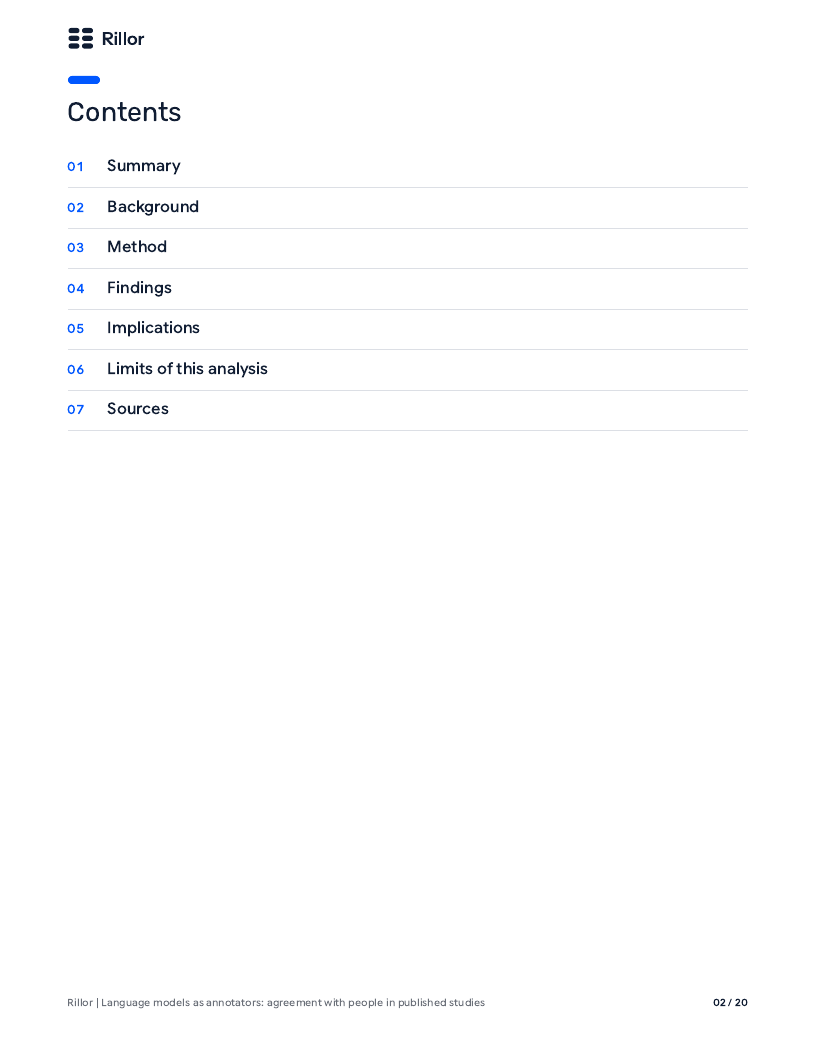
  1. Summary
  2. Background
  3. Method
  4. Findings
  5. Implications
  6. Limits of this analysis
  7. Sources

Sources

  1. Want To Reduce Labeling Cost? GPT-3 Can Help. Shuohang Wang, Yang Liu, Yichong Xu and others, Findings of EMNLP 2021, arXiv 2108.13487, version 1, 30 August 2021, viewed 8 November 2026. https://arxiv.org/abs/2108.13487
  2. Is GPT-3 a Good Data Annotator? Bosheng Ding, Chengwei Qin, Linlin Liu and others, Proceedings of the 61st Annual Meeting of the ACL (Volume 1: Long Papers), pp. 11173-11195, July 2023, viewed 8 November 2026. https://aclanthology.org/2023.acl-long.626/
  3. ChatGPT Outperforms Crowd-Workers for Text-Annotation Tasks. Fabrizio Gilardi, Meysam Alizadeh and Maël Kubli, Proceedings of the National Academy of Sciences 120(30), e2305016120, 2023, arXiv 2303.15056, version 2, 19 July 2023, viewed 8 November 2026. https://arxiv.org/abs/2303.15056
  4. ChatGPT-4 Outperforms Experts and Crowd Workers in Annotating Political Twitter Messages with Zero-Shot Learning. Petter Törnberg, working paper, arXiv 2304.06588, version 1, 13 April 2023, viewed 8 November 2026. https://arxiv.org/abs/2304.06588
  5. Can ChatGPT Reproduce Human-Generated Labels? A Study of Social Computing Tasks. Yiming Zhu, Peixian Zhang, Ehsan-Ul Haq and others, preprint, arXiv 2304.10145, version 2, 22 April 2023, viewed 8 November 2026. https://arxiv.org/abs/2304.10145
  6. Can Large Language Models Transform Computational Social Science? Caleb Ziems, William Held, Omar Shaikh and others, Computational Linguistics 50(1), pp. 237-291, March 2024, viewed 8 November 2026. https://aclanthology.org/2024.cl-1.8/
  7. Automated Annotation with Generative AI Requires Validation. Nicholas Pangakis, Samuel Wolken and Neil Fasching, preprint, arXiv 2306.00176, version 1, 31 May 2023, viewed 8 November 2026. https://arxiv.org/abs/2306.00176
  8. Testing the Reliability of ChatGPT for Text Annotation and Classification: A Cautionary Remark. Michael V. Reiss, preprint, arXiv 2304.11085, version 1, 17 April 2023, viewed 8 November 2026. https://arxiv.org/abs/2304.11085
  9. Are Chatbots Reliable Text Annotators? Sometimes. Ross Deans Kristensen-McLachlan, Miceal Canavan, Márton Kardos and others, PNAS Nexus 4(4), 2025, arXiv 2311.05769, version 2, 25 February 2025, viewed 8 November 2026. https://arxiv.org/abs/2311.05769
  10. AnnoLLM: Making Large Language Models to Be Better Crowdsourced Annotators. Xingwei He, Zhenghao Lin, Yeyun Gong and others, Proceedings of NAACL 2024 (Volume 6: Industry Track), pp. 165-190, June 2024, viewed 8 November 2026. https://aclanthology.org/2024.naacl-industry.15/
  11. Evaluating Large Language Models as Expert Annotators. Yu-Min Tseng, Wei-Lin Chen, Chung-Chi Chen and Hsin-Hsi Chen, COLM 2025, arXiv 2508.07827, version 1, 11 August 2025, viewed 8 November 2026. https://arxiv.org/abs/2508.07827
  12. LLMs as Span Annotators: A Comparative Study of LLMs and Humans. Zdeněk Kasner, Vilém Zouhar, Patrícia Schmidtová and others, MME workshop at EACL 2026, arXiv 2504.08697, version 4, 2 February 2026, viewed 8 November 2026. https://arxiv.org/abs/2504.08697
  13. Large language models struggle with ethnographic text annotation. Leonardo S. Goodall, Dor Shilton, Daniel A. Mullins and Harvey Whitehouse, preprint, arXiv 2601.12099, version 1, 17 January 2026, viewed 8 November 2026. https://arxiv.org/abs/2601.12099
  14. LLMs for automatic annotation of Mandarin narrative transcripts. Qingwen Zhao, Hongao Zhu, Yunqi He and others, preprint, arXiv 2605.17205, version 1, 17 May 2026, viewed 8 November 2026. https://arxiv.org/abs/2605.17205
  15. GPT is Not an Annotator: The Necessity of Human Annotation in Fairness Benchmark Construction. Virginia K. Felkner, Jennifer A. Thompson and Jonathan May, Proceedings of the 62nd Annual Meeting of the ACL (Volume 1: Long Papers), pp. 14104-14115, August 2024, viewed 8 November 2026. https://aclanthology.org/2024.acl-long.760/
  16. Sociodemographic Prompting is Not Yet an Effective Approach for Simulating Subjective Judgments with LLMs. Huaman Sun, Jiaxin Pei, Minje Choi and David Jurgens, Proceedings of NAACL 2025 (Volume 2: Short Papers), pp. 845-854, April 2025, arXiv 2311.09730, version 2, 17 February 2025, viewed 8 November 2026. https://arxiv.org/abs/2311.09730
  17. Using Large Language Models for Qualitative Analysis can Introduce Serious Bias. Julian Ashwin, Aditya Chhabra and Vijayendra Rao, Sociological Methods & Research 55(3), pp. 795-839, 2025, arXiv 2309.17147, version 2, 5 October 2023, viewed 8 November 2026. https://arxiv.org/abs/2309.17147
  18. The "Problem" of Human Label Variation: On Ground Truth in Data, Modeling and Evaluation. Barbara Plank, Proceedings of EMNLP 2022, pp. 10671-10682, December 2022, viewed 8 November 2026. https://aclanthology.org/2022.emnlp-main.731/
  19. How is ChatGPT's behavior changing over time? Lingjiao Chen, Matei Zaharia and James Zou, Harvard Data Science Review 6(2), 2024, arXiv 2307.09009, version 3, 31 October 2023, viewed 8 November 2026. https://arxiv.org/abs/2307.09009
  20. Large Language Model Hacking: Quantifying the Hidden Risks of Using LLMs for Text Annotation. Joachim Baumann, Paul Röttger, Aleksandra Urman and others, preprint, arXiv 2509.08825, version 2, 6 October 2025, viewed 8 November 2026. https://arxiv.org/abs/2509.08825
  21. Using Imperfect Surrogates for Downstream Inference: Design-based Supervised Learning for Social Science Applications of Large Language Models. Naoki Egami, Musashi Hinck, Brandon M. Stewart and Hanying Wei, NeurIPS 2023, arXiv 2306.04746, version 3, 14 January 2024, viewed 8 November 2026. https://arxiv.org/abs/2306.04746
  22. Prediction-Powered Inference. Anastasios N. Angelopoulos, Stephen Bates, Clara Fannjiang and others, Science 382(6671), 2023, arXiv 2301.09633, version 4, 9 November 2023, viewed 8 November 2026. https://arxiv.org/abs/2301.09633
  23. Can Unconfident LLM Annotations Be Used for Confident Conclusions? Kristina Gligorić, Tijana Zrnic, Cinoo Lee and others, NAACL 2025, arXiv 2408.15204, version 2, 8 February 2025, viewed 8 November 2026. https://arxiv.org/abs/2408.15204
  24. The Alternative Annotator Test for LLM-as-a-Judge: How to Statistically Justify Replacing Human Annotators with LLMs. Nitay Calderon, Roi Reichart and Rotem Dror, Proceedings of the 63rd Annual Meeting of the ACL (Volume 1: Long Papers), pp. 16051-16081, July 2025, viewed 8 November 2026. https://aclanthology.org/2025.acl-long.782/
  25. Agreement Is Not Quality: Blind Expert Verification of Human and LLM Qualitative Coding When Human Consensus Is Not Ground Truth. Alex Liu, Lief Esbenshade, Michael Xiao and others, preprint, arXiv 2607.28890, version 1, 30 July 2026, viewed 8 November 2026. https://arxiv.org/abs/2607.28890
  26. Agreement Metrics for LLM-as-Judge Evaluation: What to Report and Why. Delip Rao and Chris Callison-Burch, preprint, arXiv 2606.00093, version 2, 31 July 2026, viewed 8 November 2026. https://arxiv.org/abs/2606.00093
  27. Artificial Artificial Artificial Intelligence: Crowd Workers Widely Use Large Language Models for Text Production Tasks. Veniamin Veselovsky, Manoel Horta Ribeiro and Robert West, preprint, arXiv 2306.07899, version 1, 13 June 2023, viewed 8 November 2026. https://arxiv.org/abs/2306.07899
  28. Just Put a Human in the Loop? Investigating LLM-Assisted Annotation for Subjective Tasks. Hope Schroeder, Deb Roy and Jad Kabbara, Findings of the ACL: ACL 2025, pp. 25771-25795, July 2025, viewed 8 November 2026. https://aclanthology.org/2025.findings-acl.1323/
  29. Knowledge Distillation in Automated Annotation: Supervised Text Classification with LLM-Generated Training Labels. Nicholas Pangakis and Samuel Wolken, Proceedings of the Sixth Workshop on Natural Language Processing and Computational Social Science, arXiv 2406.17633, version 1, 25 June 2024, viewed 8 November 2026. https://arxiv.org/abs/2406.17633

Bring us records to label.

Send a sample of the records, the labels your schema sets and the accuracy you need.

Scope a labeling project